Meet the Puffins – The Clowns of the Sea
With their oversized colourful beaks, bright orange feet and slightly comical waddle, it isn’t difficult to see why puffins have earned the nickname “clowns of the sea”. They are wonderfully quirky little birds, full of character, and exactly the sort of wildlife that makes me want to reach for my sketchbook.
But behind their rather amusing appearance is a much tougher story.
I recently watched a nature programme following puffins during the breeding season, and what stayed with me wasn’t simply how entertaining these little birds are. It was how incredibly hard they have to work to raise their young, and some of the obstacles they face simply trying to get a meal back to their chicks.
That sent me off to find out more.
Life Isn’t Always Funny for a Puffin
What first caught my attention while watching the programme was just how hard puffins have to work during the breeding season. While their chicks, rather endearingly known as pufflings, wait in their burrows, the adults head out to sea in search of small fish such as sandeels.
Finding enough food can mean travelling considerable distances, diving repeatedly and then making the journey back with a beak full of fish. Even then, success isn’t guaranteed. Other seabirds may try to steal their catch before they reach the burrow, meaning a hard-won meal intended for a hungry puffling can disappear at the final hurdle.
And the burrow itself isn’t necessarily a safe haven. Puffin eggs and chicks can also fall prey to predators, particularly where rats or other non-native mammals have found their way onto breeding islands. Other birds can pose a threat to pufflings too.
Sadly, this daily struggle is part of a much bigger picture. Puffins depend heavily on healthy seas and plentiful supplies of small fish, but climate change, changes in food availability and fishing pressures are making life increasingly difficult. Severe weather can also make feeding harder and damage or flood nesting burrows, while introduced predators such as rats pose a further threat to eggs and chicks.
The numbers reflect those pressures. The latest UK seabird census found that around 23% of puffins have been lost from sites surveyed using comparable methods over the past 20 years, and puffins are now on the UK Red List of Birds of Conservation Concern.
Those aren’t particularly cheerful statistics for a bird nicknamed the clown of the sea. Thankfully, however, my research didn’t end there.
When Conservation Makes a Difference
The encouraging part of my research was discovering that, when we give puffins a helping hand, they can respond remarkably well.
One of the most striking examples comes from Lundy Island in the Bristol Channel. An island restoration project removed invasive rats, which prey on seabird eggs and chicks, and Lundy was declared rat-free in 2006. Puffin numbers have since risen from just 13 birds in 2000 to 1,317 in 2025.
There is good news elsewhere too. On Rathlin Island, conservationists and the local community have been working to remove invasive rats and ferrets from one of Northern Ireland’s most important seabird colonies. In March 2026, Rathlin was officially declared ferret-free — the first successful eradication of feral ferrets from an inhabited island anywhere in the world. Puffin numbers there reached 1,719 in 2025, almost 50% higher than the previous year.
Puffins have also received some much-needed help at sea. After decades of campaigning, industrial fishing for sandeels — an important food source for puffins and other seabirds — was closed in all Scottish waters and the English North Sea in 2024. Following a subsequent challenge, an international arbitration panel upheld the ecological case for protecting the sandeels in 2025.
None of this means that puffins are out of trouble. But I find these stories enormously encouraging. They show that conservation isn’t simply about documenting what we are losing. Given the right protection, wildlife really can recover.
From Research to My Sketchbook
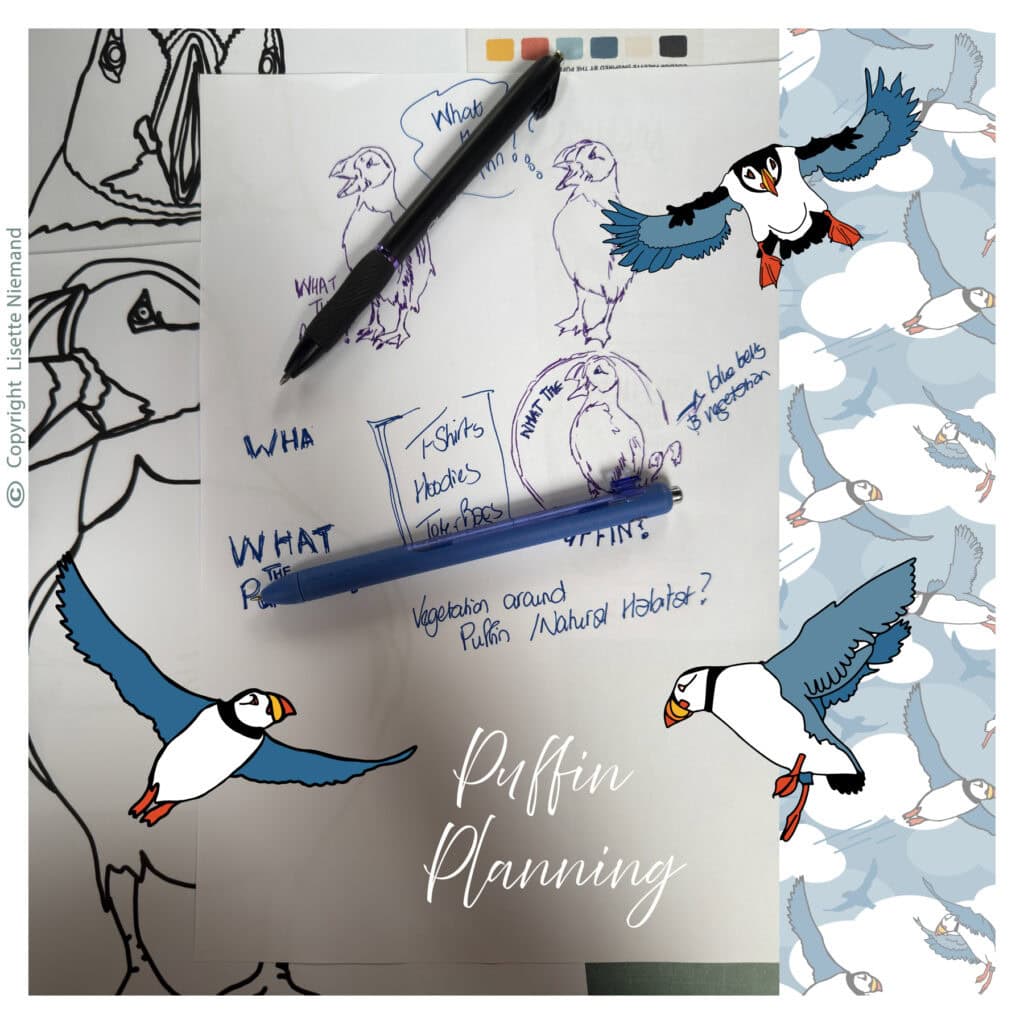
The more I learnt about these extraordinary little birds, the more I wanted to draw them. Their conservation story may be serious, but puffins themselves have such wonderfully expressive faces and comical personalities that it is almost impossible not to have a little fun with them.
Seeing puffins in the wild has now firmly found its way onto my bucket list too. Scotland has some wonderful places to see them during the breeding season, including the Isle of May, home to one of Britain’s largest puffin colonies. Until I manage to make that trip, however, I’ll have to settle for getting to know them through research, photographs — and plenty of sketching.
And those sketches have already started taking me somewhere rather unexpected.
Turning Inspiration into Action
The puffin is just the beginning of something I hope to build gradually as the Advocating for Nature side of SassiNiemand develops.
Alongside the surface pattern collections I already create, I want to begin exploring individual wildlife characters and artwork that can eventually be used to help raise awareness and support conservation. Some may become designs for clothing or other carefully chosen products, while others may simply begin with a story that encourages someone to look a little more closely at the wildlife we share our planet with.
My first puffin sketches are already starting to develop into a design for oversized T-shirts and hoodies. It isn’t quite finished yet, and there are still plenty of ideas being scribbled around the edges of my sketchbook, but I’m hoping to spend some time developing it while I’m away over the next few weeks.
For now, I’m keeping the finished design under wraps.
Watch this space — the puffins are coming.
Nature Notes | What’s a Puffling?
A baby puffin is rather charmingly known as a puffling. Puffins usually raise just one chick each breeding season, with both parents sharing the work of incubating the egg and bringing fish back to their youngster.
After several weeks tucked away in its burrow, the young puffling eventually heads out towards the sea and begins life on its own — often making that first journey under the cover of darkness.