
A More Intentional Way of Working
Creative organisation has become a natural focus for me this month. The last couple of months have been about putting things in order.
Not everything is finished, and I don’t think it ever really will be. It’s been a much bigger job than I first expected, and there are still areas I will keep refining as I go.
But I’ve reached a point where things feel clear enough to move forward.
The foundations are stronger. My work is more organised, my collections make more sense, and the way I’m presenting everything feels more aligned with what I want to put out into the world. That shift is also starting to show in how I share my work, posting more regularly and with intention on LinkedIn and Pinterest, while Instagram is still very much a work in progress.
There is a difference between feeling ready and being completely finished, and I’ve realised I don’t need to wait for one to start the other.
And that has made it easier to take the next step. Not just continuing to organise, but starting to actively share my work with more intention.
Choosing What Deserves My Focus
Now that things feel more organised, the next challenge has been deciding where to focus my time and energy.
For a long time, I worked on whatever felt interesting in the moment. That worked when I was learning, but it also meant my time and energy were spread across too many ideas at once.
Taking part in different creative challenges played a big part in that stage. They helped me build my skills as an illustrator and explore new ideas, often sparking the starting point for collections. But over time, they also added to the volume of work that I hadn’t fully developed or structured.
With everything laid out more clearly now, it’s easier to see what feels aligned and what doesn’t. Not every collection needs to be developed further, and not every idea needs to be followed through.
Instead, I’m focusing on a smaller number of collections that feel stronger and more cohesive. The ones that can be developed from hero designs into more complete collections, ready to be presented with more intention.
This shift in focus has also brought a slightly lighter rhythm back into my days, and this month’s recipe felt like a natural reflection of that.
This level of creative organisation is starting to shape how I approach everything else in my business.
🍋 Studio Lemon Poppy Seed Cake
Description
This Lemon Poppyseed Cake is a tender, moist cake that’s full of lemon flavor and poppy seeds! It’s covered in a light lemon cream cheese frosting for a cake that’s perfect for lemon lovers!
Ingredients
Lemon Poppyseed Cake
- 2 1/2 cups (325g) all purpose flour
- 1 3/4 tsp baking powder
- 1/4 tsp baking soda
- 1/2 tsp salt
- 1/2 cup (112g) unsalted butter, room temperature
- 1/2 cup (120ml) vegetable oil
- 1 1/2 cups (310g) sugar
- 1/2 tsp vanilla extract
- 4 large eggs
- 3/4 cup (180ml) milk
- 1/2 cup (120ml) fresh lemon juice
- 2 tbsp fresh lemon zest
- 2 tbsp poppy seeds
Lemon Cream Cheese Frosting
- 16 oz (452g) cream cheese, room temperature
- 3/4 cup (172g) butter, room temperature
- 10 cups (1150g) Icing sugar / powdered sugar
- 1 tbsp fresh lemon juice
- 1 tbsp fresh lemon zest
Method
- Preheat oven to 350°F / 175°C. Prepare three 8-inch cake pans with parchment and grease the sides.
- Combine flour, baking powder, baking soda, and salt. Set aside.
- Beat butter, oil, sugar, and vanilla until light and fluffy (for about 2 minutes). Needs to be really creamy in texture.
- Add eggs one at a time, mixing well after each.
- Add half the dry ingredients and mix gently.
- Combine milk and lemon juice, then slowly add to mixture.
- Now add remaining dry ingredients and mix until smooth.
- Gently stir in lemon zest and poppy seeds.
- Divide batter between pans and bake for 22–25 minutes (until a toothpick comes out dry).
- Cool briefly (2 to 3 minutes), then transfer to racks to cool completely.
Frosting & Assembly
- Beat cream cheese and butter until smooth.
- Add half the icing sugar and mix until smooth.
- Add lemon juice and zest – mix well.
- Add remaining sugar and mix until smooth (you can add more or less icing sugar for consistency).
- Remove the domes from the cakes with a serrated knife if needed, so that they are flat and ready for assembly.
- Layer with frosting between each layer.
- Frost the outside of the cake.
- Decorate as desired with simple floral rosettes and poppy seeds as a final touch.
- Chill / refrigerate until ready to serve.
Studio Note
The butter brings flavour, while the oil keeps the cake light and moist. The poppy seeds add texture and a subtle contrast, which feels fitting as I’ve been working on new poppy-inspired designs in the studio.
Developing Collections With Purpose
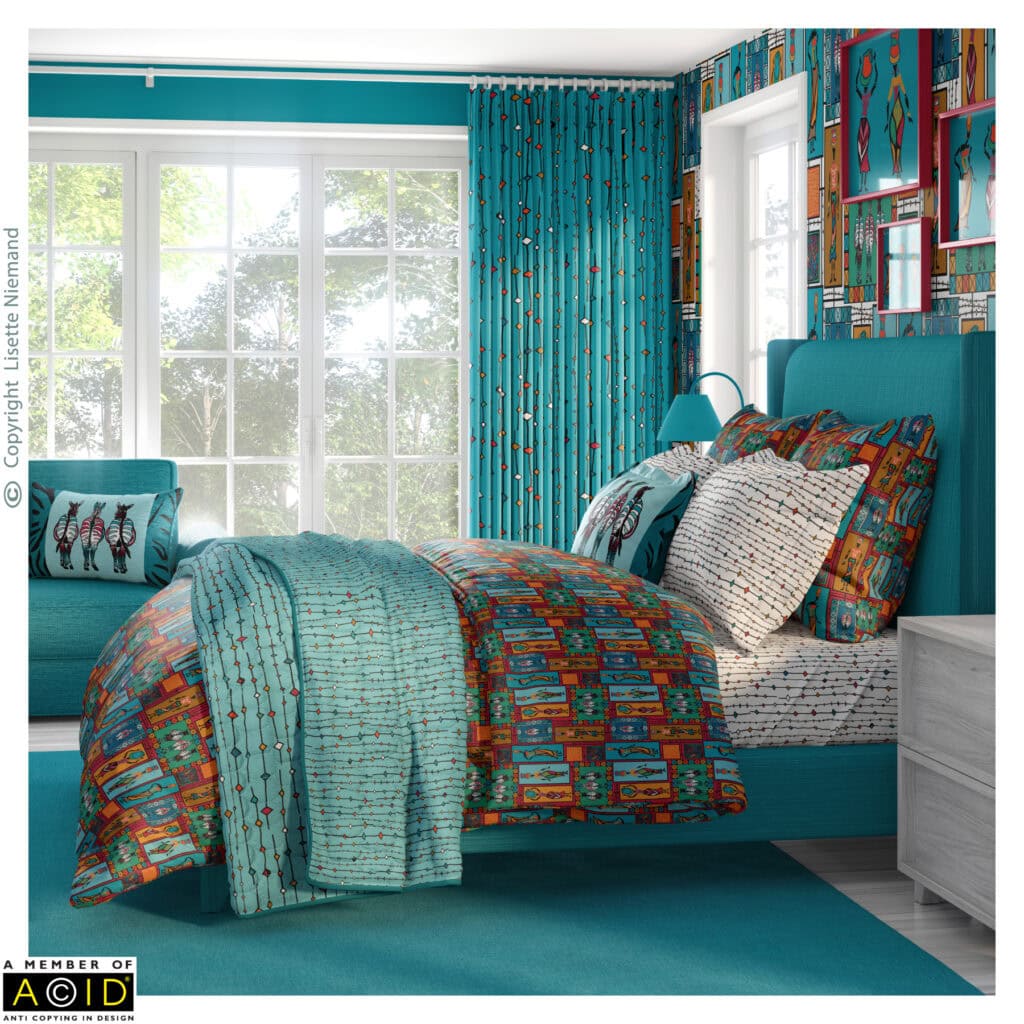
One of the collections I’ve been focusing on more intentionally is my African Tapestry collection.
It’s a body of work that feels closely connected to my roots, and one that I want to continue developing with more depth and cohesion. Rather than adding new designs for the sake of it, I’ve been thinking about how each piece contributes to a stronger, more complete collection that could sit confidently within a portfolio, rather than being created for print-on-demand platforms like Spoonflower.
At the same time, I’ve also been working on collections like Seaside Shenanigans, which take a different direction and feel suited to a different kind of market. Looking at both side by side has made me more aware of how important it is to consider not just the design itself, but where it fits and who it’s for.
That’s been another shift for me. Not every collection needs to do everything. Some are better suited to certain audiences or applications, and part of moving forward with more intention is recognising those differences and developing each collection accordingly.
It’s a more considered way of working, but one that feels much more aligned with how I want to present my work going forward.
Beginning to Look Beyond My Studio
With a clearer sense of which collections I want to focus on, I’ve started to spend more time looking beyond my own work.
That has meant researching art directors, studios, and companies whose style and direction feel aligned with what I’m creating. Not in a way that changes my work, but in a way that helps me understand where it might sit and how it could be presented.
It’s a different kind of process. Less about creating, and more about observing, refining, and making thoughtful decisions about where my work might fit best.
There’s a lot to take in at this stage, and I’m still finding my way through it. I have sent out my portfolio to various companies before and spent time researching where my work might fit, so this isn’t entirely new. But approaching it now, with more organised collections and a clearer way of presenting my work, feels very different.
Instead of trying to position everything everywhere, I can start to see more natural connections between certain collections and the kinds of companies or projects they might be suited to, it feels more considered this time.
Preparing My Work to Be Seen
All of this has naturally led into how I’m preparing my work to be seen.
With clearer collections and a better understanding of where they might fit, I’ve been looking again at how everything is presented, particularly on my website. Making sure that what I show feels intentional, cohesive, and easy to navigate, rather than overwhelming.
It’s not about adding more. If anything, it’s been about showing less, but doing it more thoughtfully. Letting collections speak for themselves, and making it easier for someone viewing my work to understand the direction behind it.
That shift has made the idea of sharing my portfolio feel more manageable. Not because everything is finished, but because it feels ready enough to represent where I am now. It feels like a more honest reflection of my work, rather than trying to show everything at once.
Moving Forward, One Step at a Time
There is still plenty to develop, and I know this process will keep evolving. But for now, it feels like a shift from simply creating and organising, to making more intentional decisions about what I do next and where my work might go.
Running a small business on my own means wearing many hats, balancing creative work with marketing, planning, and everything in between, so progress often happens in steady steps rather than big leaps.
Creative organisation might not be obvious at first, but it builds quietly in the background.
And that feels like a good place to be.